Charting a Course
Great pediatricians don’t just appear. Someone taught them. Someone showed them how to explain a frightening diagnosis to anxious parents. Someone taught them when to trust their instincts, when to ask for help and when to step in. Someone showed them that medicine isn’t just about treating disease — it’s about caring for people.
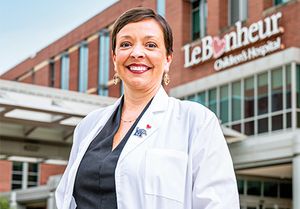
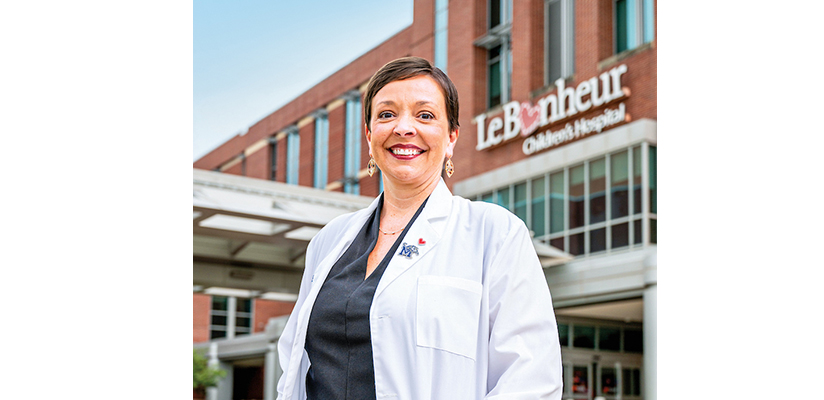
For many pediatric residents at Le Bonheur, that teacher is Elisha McCoy, MD.
As division chief of Pediatric Hospital Medicine and a professor at UT Health Sciences, McCoy spends her days caring for hospitalized children. But her impact extends well beyond the patients she sees herself. Every resident she teaches will someday care for thousands of children over the course of a career.
That ripple effect of teaching is one of the most meaningful ways donor support touches children and families across the Mid-South and beyond. That support is needed in pediatrics now more than ever, McCoy said.
“Pediatrics is in a vulnerable position right now,” McCoy said. “It’s a subspecialty that is not getting a ton of respect. But it is incredibly important. So, right now, what we need are people who see the value of pediatrics.”
A Childhood Shaped by Medicine
Long before she became division chief of Pediatric Hospital Medicine at Le Bonheur Children’s Hospital, McCoy was a little girl with a curved spine.
After McCoy’s pediatrician first noticed this, that little girl from Clarksville, Tenn., was referred to Monroe Carrell Jr. Children’s Hospital at Vanderbilt in Nashville. She spent a good deal of time at Vanderbilt undergoing treatment for scoliosis.
“I’ve literally been seeing specialty physicians since I was a year of age,” McCoy said.
Those visits — and the care she received there — left a lasting impression. So, too, did the gravity of her doctors’ advice. Her parents didn’t know anything about scoliosis or medicine, she said, so they leaned on the advice they were given by McCoy’s doctors, especially her surgeon.
“If you would have asked me — my entire life growing up — I was going to be an orthopedic surgeon because of course I was,” McCoy said.
Even though the surgeon part of her dream faded, “There was never a doubt in my mind that I was going to be a doctor.”
Four Tries to a Hard Road
For many physicians, medical school follows a predictable timeline. For McCoy, it did not. After graduating from college, she applied to medical school four times before she was accepted.
During those years, McCoy worked at Church Health, helping uninsured and underserved patients navigate the healthcare system. The experience showed her how difficult it can be for families to obtain medications, find resources and access care.
The rejections were discouraging, but they did not change her goal. When she was finally accepted to the UT Health Sciences, she carried that perseverance with her through medical school.
Today, she shares that experience with students facing rejection or self-doubt.
“If you want it, it’s worth it,” McCoy said. “The persistence is worth it. The perseverance is worth it.”
Discovering Her Calling
McCoy’s path to Le Bonheur and her specialties weren’t straight lines either.
During residency, McCoy discovered a love for caring for hospitalized patients and became increasingly interested in academic medicine. She enjoyed teaching learners, working with teams and solving complex clinical problems.
Another turn further clarified her path. Through a grant-funded quality and safety program at the Veteran’s Administration (VA), McCoy became a chief. The opportunity gave her the chance to test the waters of what it looks like to be an academic and work with students and residents.
“As a chief resident, we do schedules, we do teaching, we get to be an attending,” she said. ”But I was also able to get basic training in quality improvement and patient safety that I could bring back to the residents I was working with.”
McCoy realized she wanted a career that blended patient care, teaching and leadership. Today, she gets to do all three at Le Bonheur.
Teaching Between Patients
On some mornings at Le Bonheur, resident teams may see two dozen hospitalized children before lunch. Rounds move quickly. Questions come constantly. Families need answers. Somewhere in the middle of all that, McCoy teaches.
Pediatric resident Erin Lawrence, MD, remembers being intimidated the first time she worked with McCoy.
“Dr. McCoy is clearly very knowledgeable,” Lawrence said. “But I very quickly figured out there’s no reason to be intimidated. She is absolutely the best person that I’ve worked with in terms of teaching residents.”
Amid those whirlwind rounds in the hospital, Lawrence said McCoy has developed a remarkable ability to teach without slowing patient care.
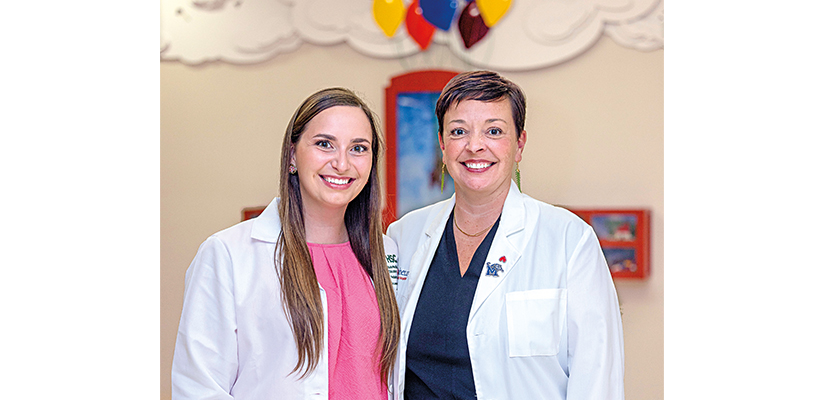
“Dr. McCoy somehow manages to teach both effectively and efficiently,” Lawrence said. “She makes sure to work in life teaching points and small pearls that are actually extremely helpful. That’s an art that Dr. McCoy has figured out very well — being both effective and efficient.”
Just as importantly, she allows residents to lead, Lawrence said. Most conversations with families begin with the residents, she said. McCoy watches and listens. Only when they need help does she step in.
“If things get a little dicey, or we’re uncomfortable, all we have to do is give her a look like, ’Hey, I don’t know how to answer this question,’ and she automatically steps in to support us,” Lawrence said.
For McCoy, that’s intentional. Residents don’t become confident physicians by watching. They become confident physicians by doing.
“I can watch a family member’s facial expression change or their body posture will change — something will happen,” McCoy said. “The residents who can pick up on that and adjust will succeed.”
Supporting a Culture of Learning
Every year, another class of residents finishes training at Le Bonheur. Some stay in the Mid-South, others return to small towns across Tennessee or build careers in children’s hospitals around the country, yet each carries forward lessons learned from physicians who invested in them. McCoy hopes their time at Le Bonheur has given them the confidence to think critically, care deeply and keep learning long after they leave the residency program.
For Le Bonheur, that culture of learning reaches far beyond the walls of the hospital. Every resident who trains here will one day care for thousands of children and families over the course of a career. Every lesson passed from teacher to student has the potential to improve countless lives. Dr. McCoy knows this better than most, returning to teach at Le Bonheur where so many others taught her.
“Training the next generation of physicians at my training institution is special because I have had some of the same experiences that these trainees are having, so I can relate in some ways,” McCoy said. “But it is also exciting to see how the training program is stronger and grown in ways that allow more opportunities for the residents than when I was in their shoes.”
Help us provide the best care for kids.
Le Bonheur Children's Hospital depends on the generosity of friends like you to help us serve 250,000 children each year, regardless of their family’s ability to pay. Every gift helps us improve the lives of children.
Donate Now