At Le Bonheur Children's Hospital, we believe that every child is different and that the care they receive should reflect that. The Craniofacial and Cleft Program at Le Bonheur Children’s Hospital offers a comprehensive and specialized approach to the care of children with craniofacial differences. Our program brings together a multidisciplinary team of highly skilled and experienced professionals who provide exceptional care. There are currently two separate clinics in the program: the craniofacial clinic and the cleft clinic.
The Craniofacial Clinic sees patients with craniofacial differences of the skull and face. The clinic sees patients of all ages, from infants to adults. This includes individuals with congenital craniofacial conditions such as craniosynostosis, hemifacial microsomia, or other rare genetic syndromes affecting the head and face. Additionally, patients who have had facial trauma or those requiring jaw surgery are also seen in the craniofacial clinic.
The Cleft Clinic is specifically designed to provide specialized care to individuals with cleft lip and/or cleft palate. The clinic serves patients of all ages, from prenatal to adult. Newborns with cleft lip and/or palate are often referred to the cleft clinic soon after birth for an initial assessment and to begin their comprehensive care journey. Children with clefts require ongoing treatment throughout their life. This includes surgical care, orthodontic care, speech therapy and other related services. We coordinate the care for you in a “one-stop shop” to make it easy on kids and families.
Our Approach
The Le Bonheur Craniofacial and Cleft Program provides comprehensive, multidisciplinary care for children with congenital and acquired differences of the face, skull, and jaws. We partner closely with families from infancy through young adulthood, focusing not only on surgical excellence but also on speech, feeding, vision, hearing, dental health, neurodevelopment and psychosocial well-being. Care is coordinated through dedicated cleft and craniofacial clinics, allowing families to see multiple specialists in a single visit whenever possible.
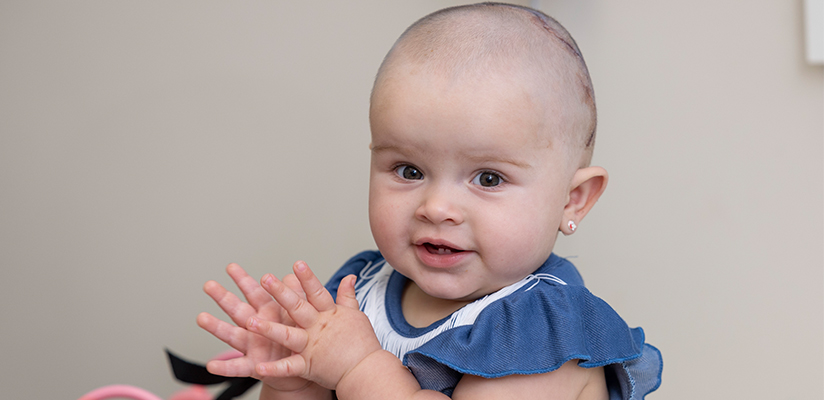
Multidisciplinary Care Model
Our team-based model ensures that every child’s treatment plan is individualized and discussed collaboratively. Families benefit from seamless communication among specialists who are experienced in complex craniofacial conditions.
Meet Our Craniofacial and Cleft Program Team
Conditions We Treat
Cleft and Jaw Conditions
We care for children with a wide spectrum of cleft and jaw-related conditions, including:
- Cleft lip and cleft palate
- Pierre Robin Sequence
- Mandibular (jaw) abnormalities
- Midface growth deficiencies
Children with these conditions often require staged care over many years. Our team emphasizes feeding support, speech development, dental health, facial growth, and appearance at every stage of treatment.
Craniofacial Syndromes
Our program has extensive experience treating children with complex craniofacial syndromes, including:
- Apert syndrome
- Crouzon syndrome
- Pfeiffer syndrome
- Muenke syndrome
- Saethre-Chotzen syndrome
- Treacher Collins syndrome
- Pierre Robin Sequence
Because these conditions can affect the skull, face, airway, hearing, vision, and neurodevelopment, care is highly individualized and often involves coordinated surgical and nonsurgical treatments over time.
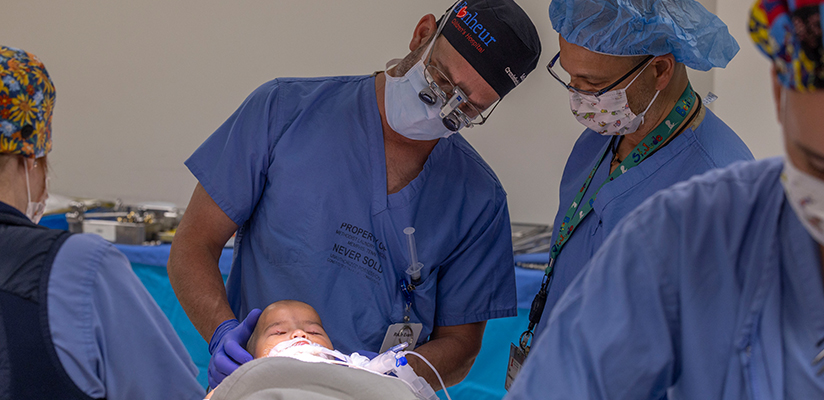
Craniosynostosis
Types of Craniosynostosis
Craniosynostosis occurs when one or more skull sutures fuse too early, altering head shape and potentially affecting brain growth. We treat all major forms, including:
- Metopic synostosis
- Coronal synostosis (unilateral and bilateral)
- Sagittal synostosis
- Lambdoid synostosis
Plagiocephaly vs Craniosynostosis
Positional plagiocephaly is a common and benign condition caused by external pressure on an infant’s skull and does not involve fused sutures. Craniosynostosis, in contrast, results from premature suture fusion and often requires surgical evaluation and treatment. Our team carefully evaluates each child to ensure an accurate diagnosis and appropriate management plan.
Treatment of Positional Plagiocephaly
For infants diagnosed with positional plagiocephaly, treatment is individualized based on age, severity, and response to early interventions.
Repositioning and Physical Therapy
- Often first-line treatment in young infants
- Includes supervised tummy time, repositioning strategies, and treatment of associated torticollis when present
Cranial Remodeling Helmet Therapy
- Recommended for select infants with moderate to severe plagiocephaly or those who do not improve with repositioning alone
- Most effective when started between 4–7 months of age, while the skull is rapidly growing
- Custom-fitted helmets gently guide skull growth toward a more symmetric shape over time
- Helmets are typically worn 23 hours per day for several months, with regular follow-up visits to monitor progress
Our team works closely with families to determine whether helmet therapy is appropriate and to ensure that positional plagiocephaly is clearly distinguished from craniosynostosis prior to treatment.
Why is Helping Families with Craniofacial Differences Important?
Craniofacial differences play a significant role in our appreciation of human diversity. These variations in the structure and appearance of the head and face contribute to the unique identities and characteristics of individuals. Embracing and valuing craniofacial differences is essential for fostering a society that celebrates diversity and promotes inclusivity.
Recognizing the importance of craniofacial differences helps challenge societal beauty standards and stereotypes, promoting acceptance and respect for individuals with varying appearances. It encourages us to shift our focus from external appearances to the inherent value and potential of every person.
Furthermore, understanding craniofacial differences is crucial in the field of medicine and health care. It allows for specialized care and treatment tailored to the specific needs of individuals with craniofacial conditions, improving their quality of life and overall well-being. By embracing and appreciating craniofacial differences, we can build a more inclusive and compassionate society that values the inherent worth and uniqueness of every individual, regardless of their physical appearance.
Guidance for Pediatricians and Primary Care Providers
Early referral allows families to receive an accurate diagnosis, reassurance, and timely access to the full range of treatment options. Referral to the Craniofacial Program is recommended when:
- Head shape asymmetry is moderate to severe or worsening over time
- There is concern for craniosynostosis, including ridging over sutures, abnormal head shape patterns, or restricted skull growth
- Plagiocephaly does not improve with repositioning and physical therapy by 4–6 months of age
- Torticollis is present or suspected
- There are associated facial asymmetries, orbital changes, or ear displacement
- The infant has a known or suspected craniofacial syndrome
- Families would benefit from specialist reassurance or longitudinal follow-up
Our team is happy to evaluate infants early, even when the diagnosis is uncertain. Early assessment helps distinguish benign positional plagiocephaly from craniosynostosis and ensures families receive clear guidance and coordinated care.
Le Bonheur Craniofacial Program’s Commitment to Cutting-Edge Research and Innovation
The Le Bonheur Craniofacial Program is committed to advancing research and innovation in the field of craniofacial surgery and care. Through ongoing research endeavors, the program aims to improve treatment outcomes, develop new surgical techniques, and enhance the overall understanding of craniofacial conditions. Here are some highlights of the research and innovation initiatives within the Le Bonheur Craniofacial Program:
- Clinical Studies: The program actively engages in clinical studies to investigate various aspects of craniofacial conditions, including their etiology, clinical outcomes and the effectiveness of different treatment approaches. These studies sometimes involve collaborations with other research institutions and involve collecting and analyzing data from a large patient population. By studying these conditions, the program aims to improve patient care and optimize treatment strategies.
- Surgical Techniques and Innovations: The Le Bonheur Craniofacial Program is at the forefront of developing and refining surgical techniques for craniofacial conditions. The program's surgeons continuously explore innovative approaches to improve surgical outcomes, minimize complications and enhance aesthetic and functional results. This may involve the use of advanced imaging technologies, computer-assisted planning and intraoperative navigation systems to achieve precision and optimize surgical outcomes.
- Genetics and Genomic Research: The program recognizes the importance of understanding the genetic motives of craniofacial conditions. Through genetic and genomic research, the program aims to identify specific genetic markers, gene mutations or epigenetic abnormalities associated with craniofacial conditions. This research contributes to a better understanding of these conditions' causes and potentially opens avenues for targeted therapies and personalized treatment approaches.
- Collaboration with Research Institutions: We actively collaborate with research institutions, universities and other medical centers to facilitate interdisciplinary research and knowledge exchange. These collaborations foster innovation and promote a comprehensive understanding of craniofacial conditions. By working together with experts in various fields, the program leverages collective expertise to drive forward research and improve patient care.
- Education and Training: In addition to research, our craniofacial program emphasizes education and training for healthcare professionals. It provides opportunities for residents, fellows and medical students to engage in research projects and gain hands-on experience in craniofacial care. By nurturing the next generation of craniofacial specialists, the program ensures a continued focus on research and innovation in the field.
- Patient-Centered Outcomes Research: The program values the perspectives and experiences of patients and their families. Patient-centered outcomes research is conducted to assess the impact of craniofacial conditions and their treatments on quality of life, functional outcomes and overall well-being. This research helps to inform and shape patient care, ensuring that it aligns with the needs and preferences of the individuals and families affected by craniofacial conditions.
Through these research and innovation initiatives, the Le Bonheur Craniofacial Program remains at the forefront of advancing the field of craniofacial surgery and care. By combining clinical expertise, collaborative partnerships and a patient-centered approach, the program aims to continually improve outcomes, develop innovative treatments and enhance the overall well-being of individuals with craniofacial conditions.

Why Choose Le Bonheur?
At Le Bonheur Children’s, we measure and track our treatment to improve the care we offer families – and to provide a greater level of transparency about our program.
Learn More